
Meet the New 'Umm'
'It engages the full expanse of the brain.' Never more so than today.
Over the years that the Banished Words List has been banishing the mis-used, over-used and generally useless, the mandarins of the Lake Superior State University have overlooked a word that some see as the kudzu of the English language, while others argue that it as influential an American cultural export as Coca-Cola or Disney.
I’m speaking about the word “fuck.”
As a case study, let’s turn to YouTube personality Diet Cokehead. Her video is above. Her transcript follows:
“Hi. This is Diet Cokehead from the past and I am talking to Diet Cokehead into the future: Do not make another dating profile. Do not — ‘Oh maybe I'm just going to look for a filming partner’ — no don't fucking do that, don't fucking do that, don't fucking do that, because like the second — the second — somebody shows you kindness you get all fucking borderline, you get crazy and you're going to fuck up your work for like five months. Don't fucking do it. He's a piece of shit. Tell him that you don't want to have sex for three months. Go tell him — like whoever the fuck you're talking to.”
“Fuck” is part of the music, the rhythm, the emphasis in Diet Cokehead’s impassioned memo to her future self. She uses fuck (or fucking) seven times in 34 seconds — about once every five seconds. Fuck is tied with “don’t/do not” as the word she uses the most.
Could a word used that often by just one person — more than “I,” more than “you,” more than “sex” — be banished, even facetiously?
My gut says I’m hearing fuck a lot more these days. Way beyond its ability to shock, to coerce or to entertain. It has colonized each weakly defended part of speech and now is infiltrating the land of filler words, so full of verbal nutrients there may be no hope of escape or turning back.
“Fuck is probably the most widespread profanity in the world,” Uppsala University informs us. “In the Nordic languages, fuck has become a well-established part of the vocabulary, while in languages such as Russian and Hindi, it is used but not established to the same extent. And in Amharic, Ethiopia’s official language, only younger people in the big cities use the profanity.”
A homesick American in Addis Ababa might feel comforted by a younger Ethiopian telling them to fuck off.
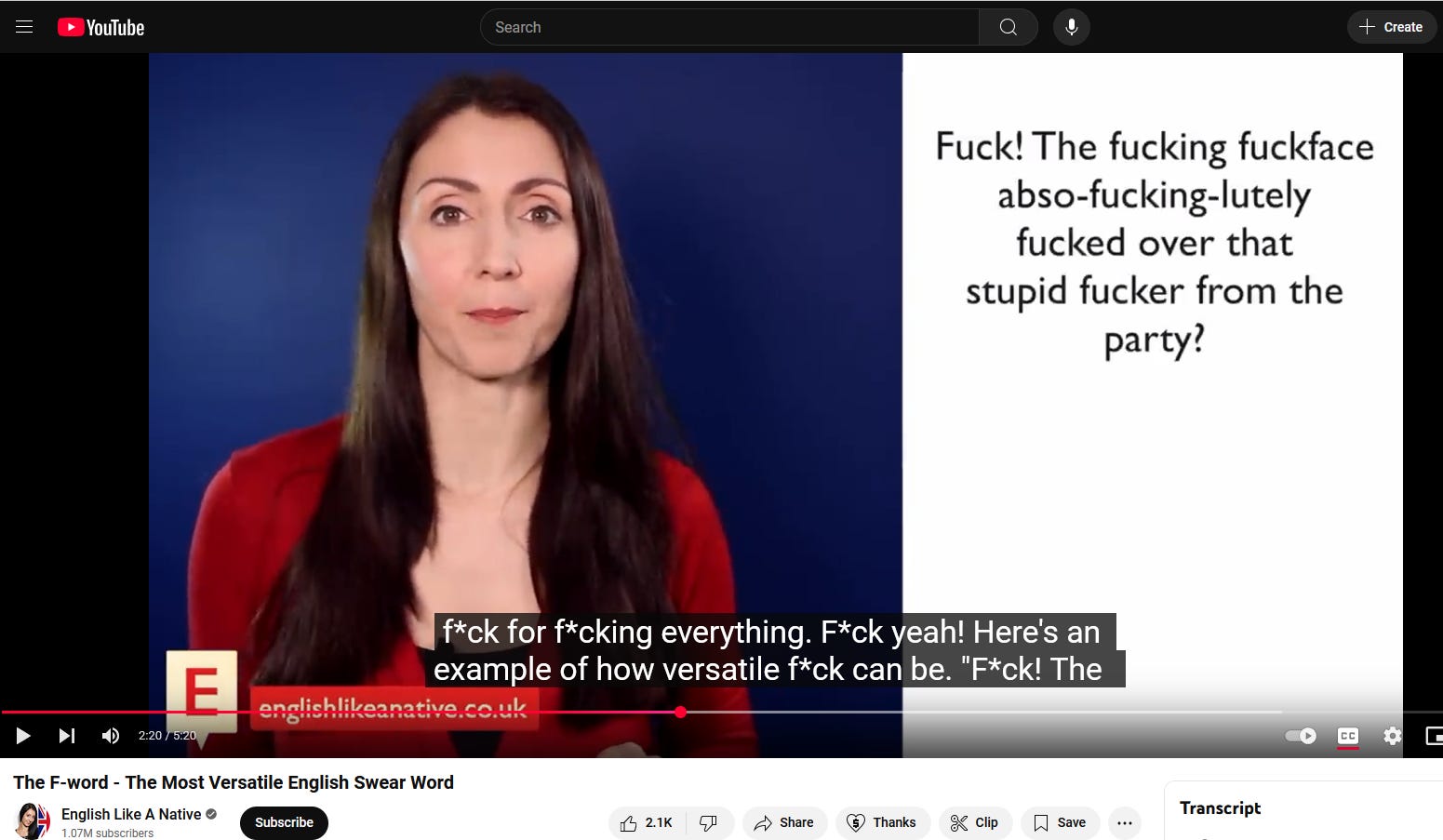
This is Anna English. “I am British, therefore I teach British English,” she says in her video wherein she teaches non-native speakers the correct and myriad uses of “fuck,” which she calls a “unique, offensive but oddly beautiful, four-letter word.”
This may be fuck’s finest hour — and the moment of its hegemony over even linguistic fillers. Is fuck now summoned wherever the brain lags — the decorative expletive? It’s beginning to seem so. Where once there was “um” is there now fuck? Is fuck the new “y’know?” Is fuck the new “like?” While Diet Cokehead uses “fuck” seven times, she uses “like” only like three times.
But in reaching this prominence, has fuck sold out?
Writing in Psychology Today, professor of linguistics Valerie Fridland quotes researchers Robbie Love and Anna Stenstrom, saying that “f@#k seems to have undergone a process linguists refer to as delexification, or an expansion of a word’s function, ultimately resulting in a decay in or loss of its original meaning. In other words, a decrease in use of a word’s literal meaning, coupled with an increase in more figurative use, weakens its meaning over time.
“Decay,” “loss,” “decrease,” “weakens” — these are words not typically associated with a robust four-letter word.
“This delexicalization process helps explain why recent studies suggest that people nowadays are less offended by the use of f@#k and swear words more generally,” she writes.
While unoffended, I am exhausted by the unrelenting barrage of fucks.
In a thread on Reddit seven years ago, two participants wrestled with both their fuck-fatigue and the lack of any suitable alternative.
“Fuck is overused. Dropping in a different word mixes things up a bit, or better to leave them out altogether.”
“Then make it a totally different word. If you say frick or friggin you just sound like you are afraid to say fuck.”
“I think it says more about you that you think it takes guts or whatever to say "fuck" on the internet than a person who uses a non-fuck F-word.”
“I don't think it takes guts to do anything on the internet.”
Fuck is a compact fireplug of an obscenity. It’s a reminder of how economical words can be. In “Why We Love the F-Word So Much,” Laura Dimon quotes “famed scientist and writer” Steven Pinker’s piece "What the F***?": As far as I know, it is the only one piece on the subject that goes so far as to use the word “combinatorial.”
"When used judiciously," Pinker wrote, "swearing can be hilarious, poignant, and uncannily descriptive. More than any other form of language, it recruits our expressive faculties to the fullest: the combinatorial power of syntax; the evocativeness of metaphor; the pleasure of alliteration, meter, and rhyme; and the emotional charge of our attitudes, both thinkable and unthinkable.
"It engages the full expanse of the brain: left and right, high and low, ancient and modern,” Pinker wrote.
Fuck reminds me of the barbecue ribs served by Adam’s Ribs, near Chicago’s Dearborn Street station, that caused Hawkeye Pierce to salivate in an early episode of “M*A*S*H”:
HAWKEYE
“Henry, they were sensational.
The ribs burned my upper lip.
I had a little cut.
I kept the scar alive for a year.
The pain was exquisite.”
When prepared just right, fuck can have the same effect:
“I’m a fucking artist; I’m sensitive as shit.”
So ranted a parody John Lennon on National Lampoon’s “Radio Dinner” album in a song with lyrics drawn from a fuck-filled interview Lennon did with Rolling Stone in 1972. (See also “Genius Is Pain”)
It wasn’t until I saw “Pulp Fiction” that I realized fuck could be played like jazz.
JULES
“Look, just because I wouldn't give no man a foot massage, don't make it right for Marsellus to throw Antwan off a building into a glass-motherfuckin-house, fuckin' up the way the nigger talks. That ain't right, man. Motherfucker do that to me, he better paralyze my ass, 'cause I'd kill 'a motherfucker.”
“Pulp Fiction” clocks in at 265 fucks, according to the Dallas Observer’s count.
It never seemed gratuitous. And by that time, I was getting tired of gratuitous.
When I was in 9th grade, George Carlin bestowed a gift on teenagers with his routine “7 Words You Can’t Say on Television.”
Of all the words that came at us in those years — war, killing, murder, hate, assassination, napalm, lies, pollution — the media, the government and the Establishment seemed most outraged by these:
Shit
Piss
Fuck
Cunt
Cocksucker
Motherfucker
and Tits
“And tits doesn’t even belong on the list, man,” Carlin said. “Such a friendly-sounding word.”
I learned the 7 Words and I was free.
“Fuck you” free.
One day on the way out of science class, I gleefully recited the 7 Words to Mrs. Duranczyk.
Shit Piss Fuck Cunt Cocksucker Motherfucker and Tits.
She responded with a high school teacher’s melding of remonstrance and rolled eyes.
“David, please don’t say that. It’s not nice.”
“It’s fine,” I insisted. They’re just words. Words can’t hurt. Fuck is just a word. It means ‘make love.’ Fuck. Fuck. Fuck. Fuck. Fuck. Fuck. Fuck. Fuck. Fuck.”
Asshole.